


On a rainy afternoon in Brisbane, a camera operator shifts half a metre to clear a guest’s umbrella while a tablet near the front row shows grandparents joining live from interstate. In moments like that, hybrid event production services stop feeling like tech jargon and start feeling like what they really are — a bridge between the room you can fill and the people who still need to be there.
If you are planning a wedding in New Farm, a memorial in a chapel, or a private hybrid gathering in South Bank, you are not shopping for gear alone. You are choosing clarity, timing, discretion, and a crew that can work with real venues, real weather, and real internet limits. This guide is for families, individuals, and organisations across Brisbane and surrounding regions who want practical options, not flashy promises.
Selection criteria: how to compare hybrid event livestream services
Match the service to the event type and audience size
Hybrid events combine an in-person audience with a remote audience at the same time. That sounds simple, but the service that works for a 20-person elopement is rarely the right fit for a larger private gathering. Start with the shape of the event: one speaker or five, quiet ceremony or audience interaction, private stream or invite-only access, one room or multiple spaces.
A short checklist helps fast. Ask how many cameras are needed, whether remote guests must see slides or only the lectern, and whether the stream will run to a private secure link. If the answers feel vague, you are probably hearing from a camera crew, not a true end-to-end operator.
| Question | Why It Matters |
|---|---|
| How many people are in the room and online? | Audience size affects camera coverage, audio needs, and support plan. |
| Is the event private, public, or invite-only? | Access settings change the link controls and delivery plan. |
| Do remote viewers need slides or live interaction? | Some events need more than a single room shot. |
Check audio, stream stability, and backup plans first
Remote viewers can forgive a less dramatic camera angle. They do not forgive missing vows, clipped eulogies, or a keynote they cannot hear. Audio quality is often more important than camera resolution because the online audience relies on the stream to hear every word. A clean lavalier, lectern feed, or backup recorder will do more for viewer experience than 4K bragging rights.
Ask direct questions about failure points. What happens if the house PA hums? What happens if venue internet drops? What happens if a handheld microphone dies during audience questions? A serious team should explain backup audio, local recording, and a second internet path in plain English.
Rule of thumb: if a provider cannot explain its backup audio and internet plan in plain English, keep looking.
Confirm local coverage, planning support, and turnaround times
Brisbane venues vary wildly. A heritage hall in Ipswich behaves differently from a glass-walled function room in Fortitude Valley, and a private home in Redland Bay brings a different set of lighting and access constraints again. Planning support matters because acoustics, lighting, and internet access can change the entire plan.
Ask whether the crew works locally, whether they can discuss the venue setup in advance, and how quickly they can confirm setup times, bump-in windows, and replay delivery. Local Brisbane crews are often worth favouring here — they can usually assess venue compatibility faster than a team flying blind from outside the region.
#1 Full-service hybrid event production team
If you want one crew to run the room, the stream, and the schedule from the first sound check to the final sign-off, this is the cleanest option. Best for clients who would rather solve the whole event with one accountable team than coordinate three separate suppliers.
Best for weddings, funerals, and private hybrid events
This service suits events with mixed needs: a live room to manage, guests joining remotely, and moments that cannot be repeated. Think weddings with interstate family, memorials with private access, and intimate events that need both in-person and remote participation.
- Best for: one-off events where reliability matters more than experimentation
- Typical scale: small private gatherings to mid-size hybrid events
- Main benefit: one crew owns the outcome
What it usually includes: cameras, switching, audio, and live output
A full-service team typically covers cameras, live switching, encoding, audio mixing, and on-site coordination. In practice, that means they are not just pointing lenses at a stage. They are taking feeds from microphones, monitoring levels, switching between angles, delivering a private stream link, and watching for issues as the run sheet moves.
For many Brisbane events, that full chain is the difference between a stream that feels composed and one that feels improvised.
Why one point of contact reduces handoff mistakes
Using one vendor can reduce gaps between the venue, audio, and streaming roles. If the lectern mic is too low, the switching laptop loses sync, or the stream needs to pause for a private moment, you do not want a debate about whose job it was. You want one producer on headset making decisions quickly.
Choose this option when the event cannot afford blame-shifting between separate AV and streaming vendors.
#2 Wedding livestream production
Wedding livestream production works best when it feels almost invisible. You want remote guests to feel included, but you do not want the ceremony to turn into a studio set with cables in the aisle and crew stepping through every photo.
Best for intimate ceremonies, elopements, and larger receptions
This is the right fit if your guest list spans cities or countries — Brisbane to Perth, Auckland, or London — and key people cannot travel. It also suits couples planning smaller ceremonies with a wider online audience, as well as larger receptions where speeches matter just as much as the walk down the aisle.
- Best for: couples prioritising absent family and friends
- Typical moments covered: ceremony, vows, speeches, first dance
- Main benefit: emotional inclusion without crowding the room
What it usually includes: discreet camera placement and ceremony audio capture
Wedding livestreams often work best with minimal crew movement and discreet camera positions. Expect one or two locked-off cameras, a clear shot of the couple, careful microphone placement, and coverage that respects the venue layout — whether that is a chapel, garden, or waterfront setting.
For remote relatives, clear vows, speeches, and toasts usually matter more than cinematic tracking shots. If the audio lands cleanly, the stream already feels far more intimate.
Why the setup should stay unobtrusive and ceremony-friendly
Good wedding production has restraint. The best crew anticipates where guests will stand, how photographers need space, and when not to move at all. That matters at St John’s Cathedral just as much as it does at a backyard ceremony in Samford.
For weddings, the best production is the one guests barely notice.
#3 Funeral and memorial livestreaming
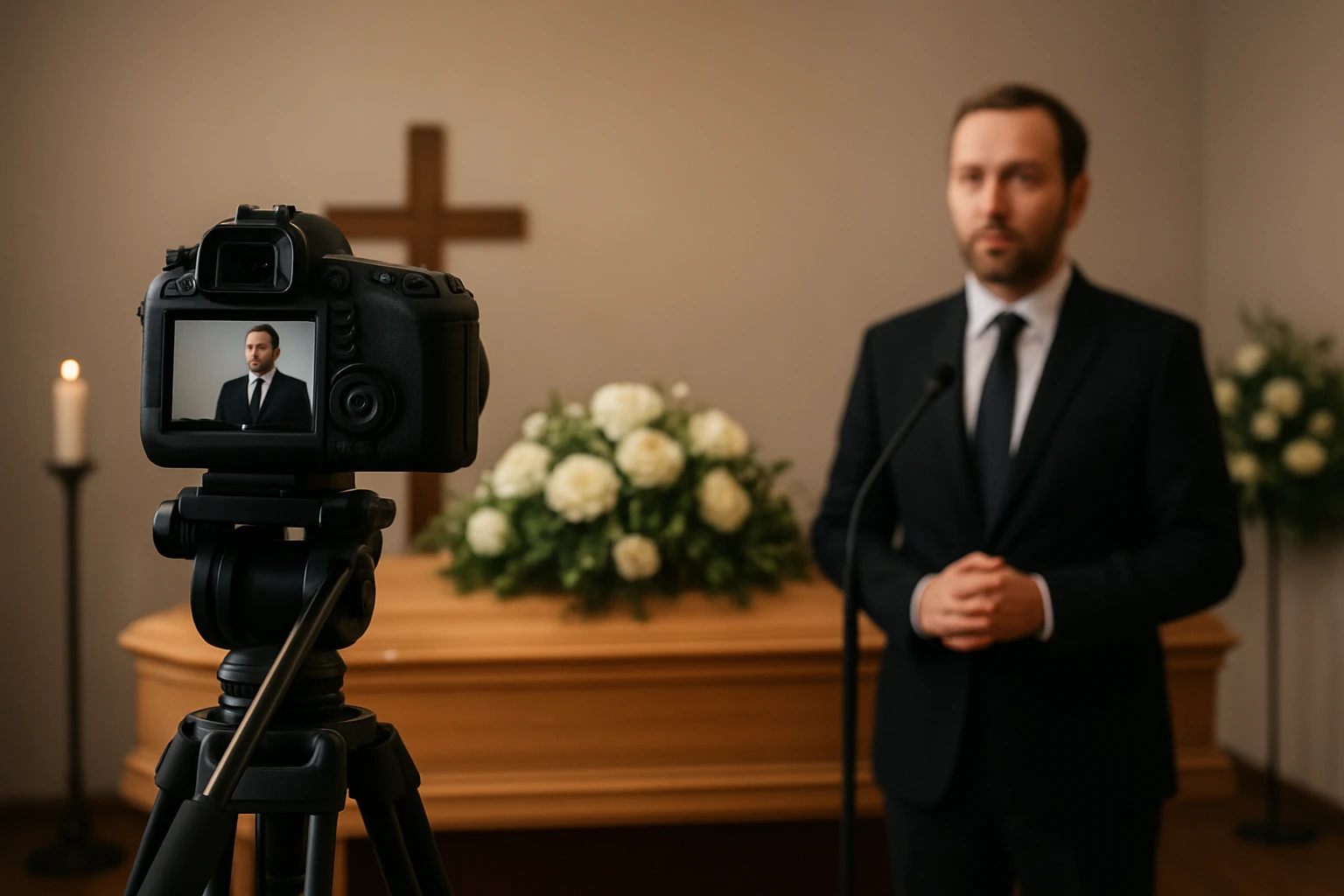
When relatives cannot travel, livestreaming can give them a quiet way to witness, remember, and say goodbye. This service is less about coverage style and more about trust — the crew must be calm, discreet, and reliable from the first conversation onward.
Best for chapel services, graveside moments, and memorial gatherings
Families often use this option for chapel services, cemetery gatherings, celebration-of-life events, and home-based memorials. It is especially useful when loved ones are interstate, unwell, overseas, or caring for children and cannot make last-minute travel work.
- Best for: sensitive events where privacy and steadiness matter most
- Typical access: private link or limited guest list
- Main benefit: inclusion without adding pressure to the family
What it usually includes: discreet coverage, private links, and careful audio
Memorial livestreams are usually strongest when the crew stays unobtrusive and communicates quietly with the family or funeral director. Services often include a small camera setup near the back, careful audio capture from a lectern or chapel system, and a private or limited-access stream so attendance stays controlled.
You may also want a local recording for those who cannot watch live because of time zones. That matters when viewers are joining from New Zealand, Singapore, or the UK.
Why discretion and reliability matter more than flashy visuals
This is not the place for visible gear, dramatic camera moves, or production theatrics. Families remember whether the stream worked, whether the crew was respectful, and whether instructions were simple for older relatives using a phone or tablet.
In memorial settings, professionalism is measured by respect, not by how much gear is visible.
#4 Private hybrid event livestreaming
Private events have a different job. Your remote audience needs to stay connected without the event feeling public. A simple room shot is rarely enough, but a private secure stream keeps the experience controlled and comfortable.
Best for private gatherings, family milestones, and invite-only events
This service fits private celebrations, milestone gatherings, family events, and intimate programs where some guests attend in person and others join remotely. If you need a polished but private viewing experience, this is usually the better choice.
- Best for: invite-only events with remote participation
- Typical moments covered: speeches, key moments, presentations, ceremonies
- Main benefit: remote guests can join securely and discreetly
What it usually includes: secure access, clean audio, and simple remote viewing
Private hybrid events often need careful camera coverage, clear presenter audio, and a private secure stream link. That means the online audience can follow the event without exposing it on public platforms.
For sensitive events, keeping the viewing experience straightforward matters more than adding extra features.
Why privacy and reliability matter more than flashy visuals
Private event streaming has to feel calm and dependable. The best crew anticipates where guests will stand, how speakers will move, and when not to interrupt. That matters just as much for family occasions as it does for formal private functions.
For private events, the best production is the one that protects the moment.
#5 Multi-camera event broadcast and live switching
Some events need more motion, more emphasis, and more live decision-making. If the program has stage entrances, musical performances, awards, or fast-moving panel exchanges, multi-camera coverage gives the stream rhythm.
Best for staged programs, performances, and church services
This option works well for worship services, school performances, community concerts, awards nights, and debate-style panels. Whenever the audience needs to see the speaker, the crowd reaction, and the presentation area in the same session, more than one angle pays off.
- Best for: stage-led programs with visual variety
- Typical camera plan: wide shot, close-up, and presentation angle
- Main benefit: viewers stay engaged from one moment to the next
What it usually includes: wide shot, close-up, and presentation angles
Multiple camera angles can make a stream easier to follow and more engaging for remote viewers. A common setup uses a locked wide shot for safety, a close-up for speakers or performers, and a third angle for presentation material or audience interaction.
A dedicated vision mixer can cut between wide, close, and presentation feeds in real time, which matters when the event has no natural pauses.
Why live switching keeps the audience engaged
Live switching creates pace. Instead of leaving the online audience parked on a static frame for 45 minutes, the producer can respond to applause, questions, stage movement, or a speaker stepping away from the lectern. That makes the stream feel intentional and easier to watch.
If the event has speakers and stage moments, one camera is usually the bare minimum.
#6 Venue-ready portable streaming kits
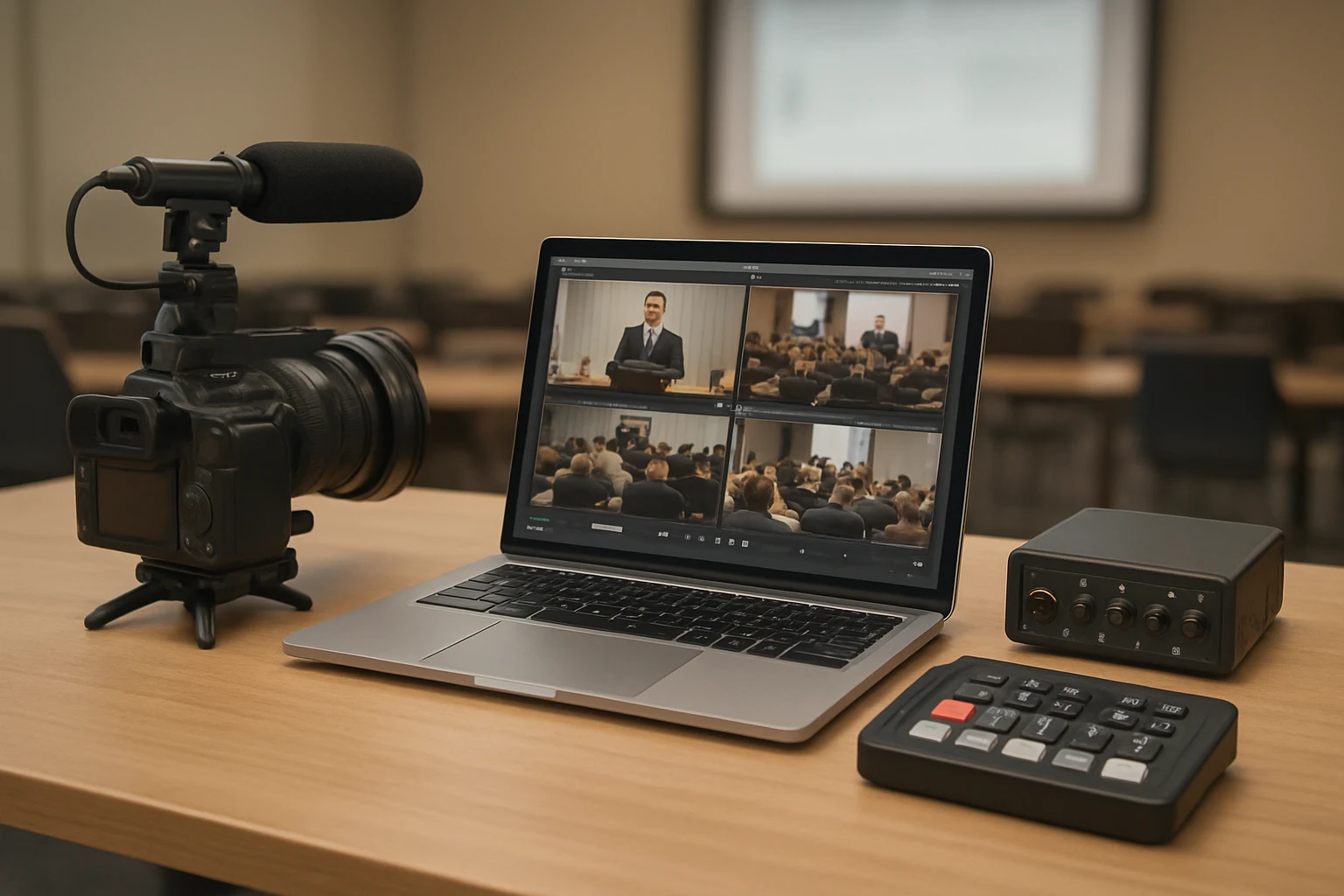
Not every location comes with installed AV, strong internet access, or even a sensible place to put a control desk. Portable streaming kits exist for exactly these situations — compact, fast to deploy, and built for spaces that were never designed as broadcast venues.
Best for small halls, private homes, community spaces, and temporary setups
This service is a smart fit for suburban community halls, private residences, school rooms, sports clubs, pop-up venues, and last-minute bookings. If the event is happening in a place with limited power, minimal sound gear, or tight bump-in windows, portability matters.
- Best for: smaller venues without fixed infrastructure
- Typical scale: short programs, memorials, meetings, local gatherings
- Main benefit: professional setup without venue dependency
What it usually includes: compact cameras, encoder, microphones, and cabling
Portable kits generally include compact cameras, an encoder, microphones, tripods, and the cabling needed to build a working stream quickly. Depending on the event, that may still deliver a polished result — just without the footprint of a larger control position.
This is especially useful when access is via stairs, narrow doorways, or a single parking bay behind a hall in Wynnum or Toowong.
Why portability helps when the venue has no fixed AV infrastructure
A smaller footprint often means faster setup, fewer trip hazards, and less disruption for guests. Just make sure the portability does not come at the cost of resilience. A backup internet option, whether that is a second connection or a mobile failover, can save the stream if the venue line behaves badly.
Portable does not mean basic; the right kit should still have a clear backup plan.
#7 Hybrid event planning and remote audience support
Some hybrid events are only partly about the room. The real challenge is getting remote viewers, live audio, cameras, and timing to line up without awkward starts or missing moments. That calls for a different kind of production discipline.
Best for hybrid ceremonies, private programs, and speaker-led events
This service fits private ceremonies, hybrid family events, and speaker-led programs where some guests are online and others are in the room. If you need a polished hybrid experience rather than a simple room feed, this is usually the better choice.
- Best for: events with both in-person and remote guests
- Typical delivery: private stream link, replay link, and live support
- Main benefit: smoother joins, steadier pacing, fewer surprises
What it usually includes: guest checks, run sheets, and live support
Hybrid events work best when the team completes audio checks and a rehearsal before going live. Good production here includes pre-flight checks for mics, lighting, and screen sharing, a run sheet that names every cue, and live support so issues can be managed quickly.
For a 60-minute event, even a short rehearsal can prevent the most common failures.
Why rehearsal matters when remote viewers are involved
Remote guests need a simple join process so the session starts on time and stays on schedule. Rehearsal helps speakers learn where to look, when to pause for transitions, and how the producer will step in if bandwidth drops or a laptop notification appears at the worst possible moment.
For hybrid sessions, the smoothest stream is usually the one that was rehearsed like a live broadcast.
How to choose the right option
Start with the audience experience you need to protect
Begin with the non-negotiable moment. For a wedding, it may be the vows. For a memorial, it is often the eulogy. For a hybrid ceremony, it might be the key moment that remote guests must not miss. Once you know the moment that must land, the right service type gets easier to spot.
| Event Need | Best-Fit Service | First Question To Ask |
|---|---|---|
| One crew for room + stream | Full-service hybrid event production team | Who owns audio, switching, and stream output? |
| Quiet ceremony with remote family | Wedding livestream production | How discreet is the camera placement? |
| Sensitive private gathering | Funeral and memorial livestreaming | Can you provide a private or limited-access link? |
| Private hybrid event with remote viewers | Private hybrid event livestreaming | How do guests access the stream securely? |
| Stage moments and visual variety | Multi-camera event broadcast and live switching | How many angles are included, and who switches them live? |
| Minimal venue infrastructure | Venue-ready portable streaming kits | What is your backup internet plan? |
| Remote guests joining live | Hybrid event planning and remote audience support | Do you run rehearsals and speaker checks? |
Work backward from the venue and the run sheet
Next, map the venue against the run sheet. Is there a lectern feed? Will speakers roam? Are there private moments that should not be shown? Does the room have hard floors and echo? In Brisbane, those details change quickly from venue to venue, and that is why good planning often pays for itself in avoided problems.
If you are comparing local providers, ask for plain-language examples from similar bookings. A capable team should be able to explain how they handled a chapel, a private residence, and a small event space without defaulting to gear jargon.
Ask the five final questions before you book
- Who is responsible on the day if audio fails or the schedule shifts?
- What backup plan exists for microphones, recording, and internet?
- Will the crew assess the venue properly in advance?
- How do guests join — private link, secure page, or invite-only access?
- What replay or recording options are available after the event?
If a provider answers those five clearly, you are usually in safer territory. If they dodge them, keep searching.
The best hybrid event production services match the event, protect the audio, and stay steady when Brisbane conditions get messy.
You do not need the biggest setup. You need the right one — sized to the room, clear for remote viewers, and backed by a plan B that makes sense.
Which part of your event matters most to protect: the vows, the eulogy, or the moment remote guests need to see?
Plan A Calm Broadcast With Livestream Company
Respectful, discreet funeral and memorial streaming helps Brisbane families, individuals, and organisations include distant guests with clear, dependable coverage.


