The Challenge of Connecting Remote Family Members
Weddings and funerals are among the few moments when most of a family wants to be in the same place. When someone cannot travel, whether because of distance, cost, visa limits, health, or work commitments, the ceremony can feel incomplete for them and for the people in the room.
Livestreaming has become the practical answer. Yet many families who try it discover that the technical side is harder than it looks. A stream that stutters, drops out mid-vows, or exposes a private service to strangers can be more stressful than having no stream at all.
If you are planning a ceremony in South East Queensland with loved ones overseas or interstate, start by listing three things: who needs to watch, what time zone they will be in, and how private the event needs to be. Those answers will shape every decision that follows.
Reliance on Venue Wi-Fi vs Independent Connectivity
Many venues advertise Wi-Fi, and for email and social media that is usually fine. Livestreaming is different. A live video feed needs a steady upload speed for the full duration of the ceremony, often one to two hours, and venue networks are rarely built for that.
Common problems with shared venue networks include:
- Bandwidth shared with guests, staff, card terminals, and other events
- Upload speeds far lower than download speeds, which is what video depends on
- Congestion at peak times, such as when a reception begins or guests arrive
- Firewalls or content filters that block streaming platforms
- Outages that are outside your control and cannot be fixed on the day
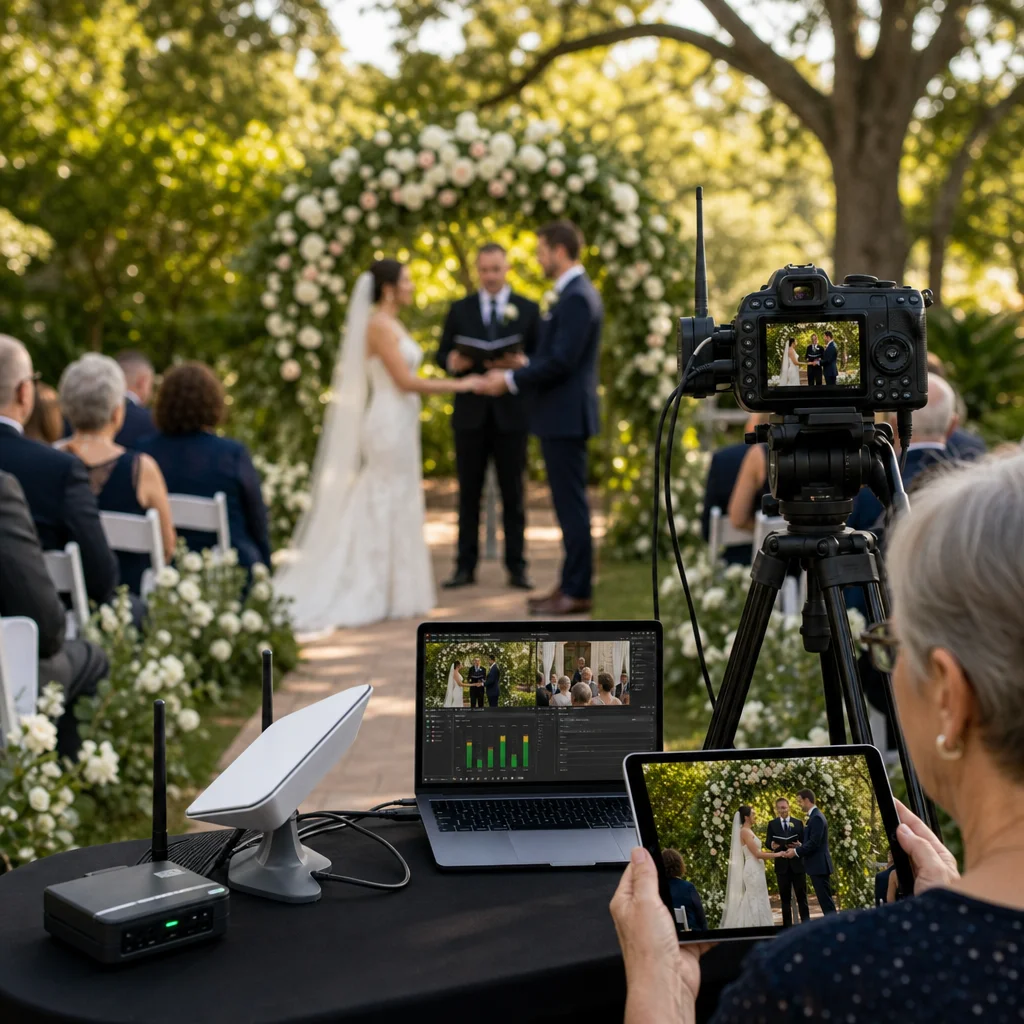
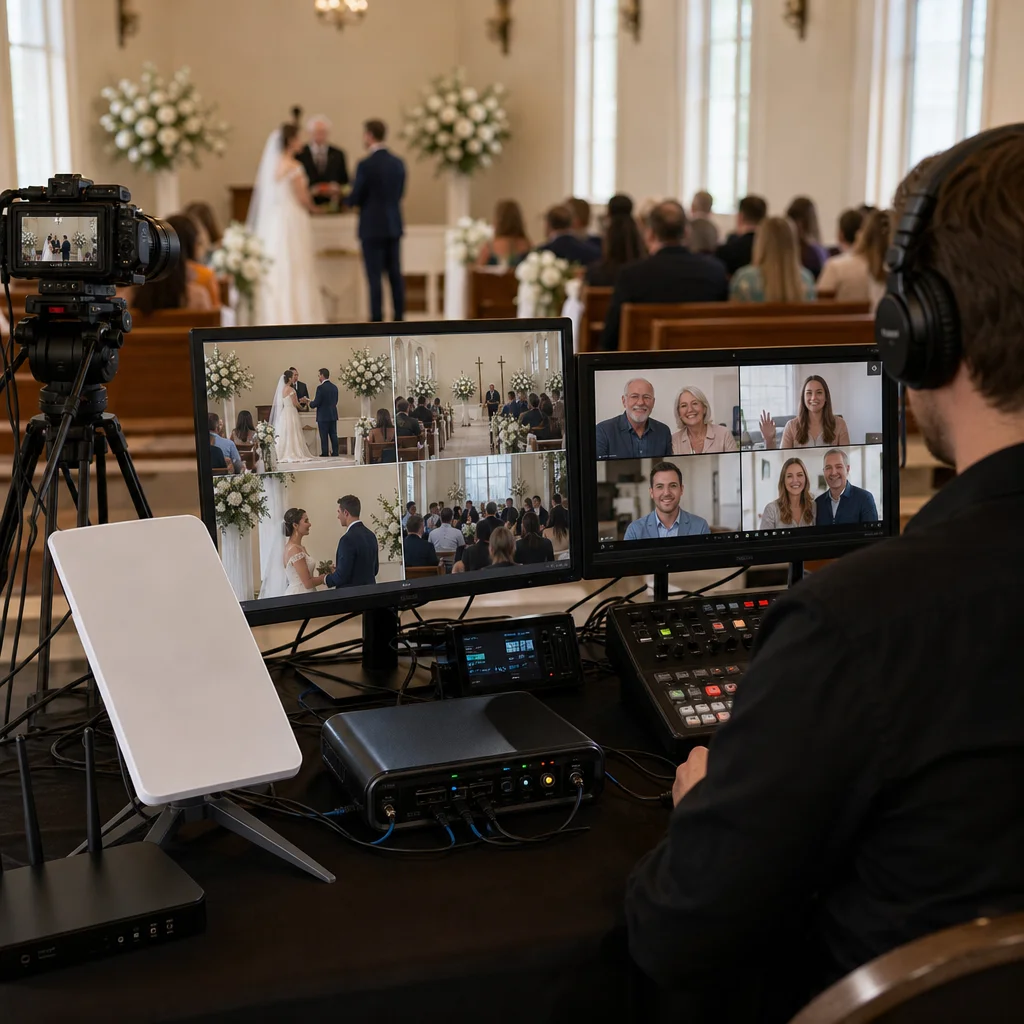
Our approach is to bring independent connectivity with us, using mobile data and Starlink where the site calls for it. This means the stream does not depend on the venue’s internet, and we can test the upload path before guests arrive. For a graveside service in a regional cemetery or a garden wedding with no reliable signal, that independence is often the difference between a working stream and a blank screen.
What to do next: Ask the venue for their upload speed and whether they allow outside network equipment. If the answer is vague, plan for independent connectivity.
Comparing Setup Discretion and Ceremony Impact
A livestream should not turn a ceremony into a production. Visible tripods, cables taped across aisles, and camera operators moving through the crowd can distract from the service and change how family members feel about being watched.
Venue-supplied setups vary widely. Some involve a fixed camera that is hard to reposition, while others rely on a guest with a phone. Neither gives you much control over framing, audio, or how the event looks on a remote screen.
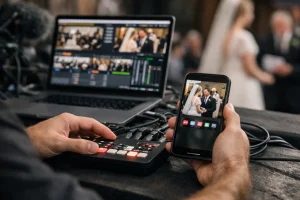
Our setup is built around low-profile equipment. We place cameras in positions that fit the room, keep cabling out of walkways, and use compact mounts that blend into the space. For funerals and graveside services in particular, we aim to be present without being noticed. Our technicians work quietly, and we agree on a discreet plan with the celebrant or funeral director before the day.
Practical tip: Walk the space with your celebrant or funeral director and mark where the speaker, the coffin or altar, and the seating will sit. Those spots determine where cameras can go without intruding.
Comparing Stream Privacy and Access Control
Privacy is one of the most important concerns for families, and it is also one of the least discussed. A public link shared on social media can be found by people who were never invited, and a link forwarded once can spread far beyond the intended audience.
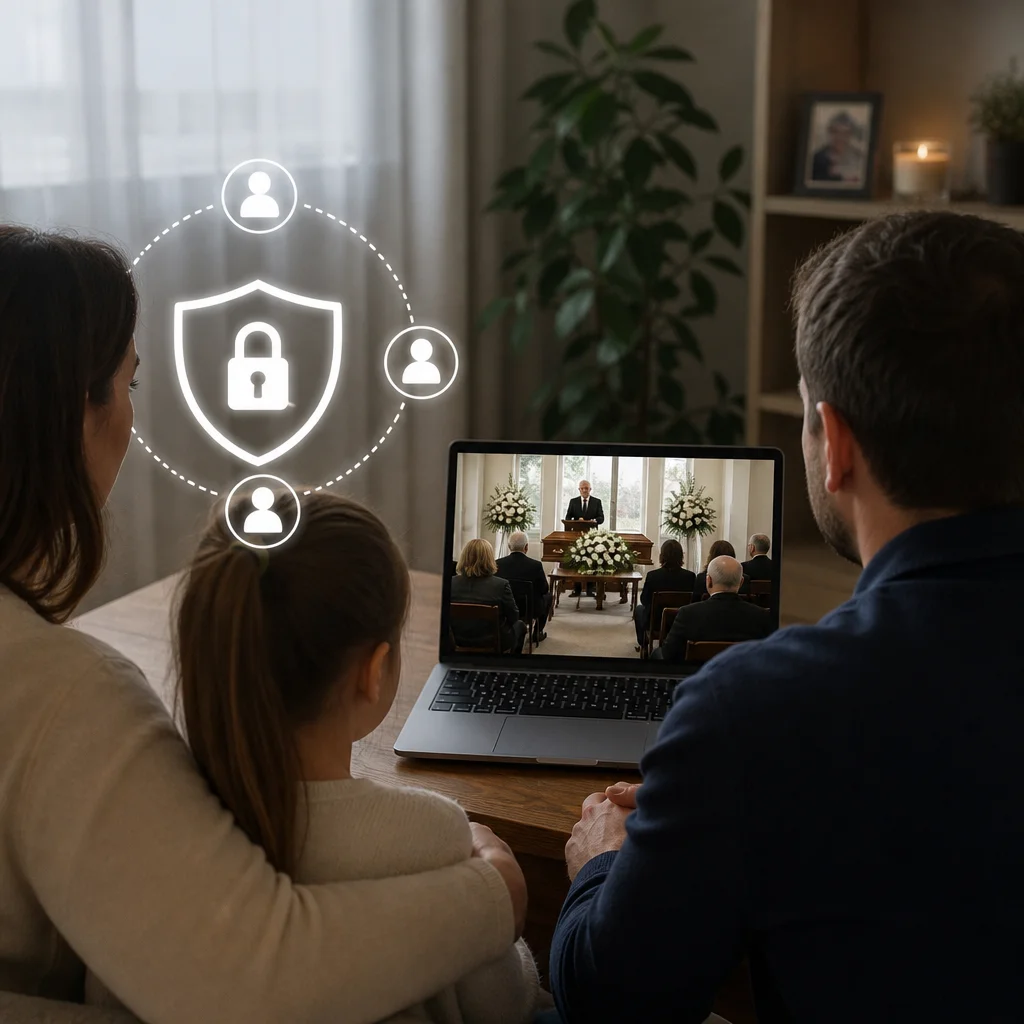
Standard venue streams often provide no access control at all. Some use a generic public URL, and there is no way to see who is watching or to shut the stream off remotely if needed.
Our streams are private and password-protected. We issue access details only to the people you choose, and we can change the password or end the session if the list of viewers changes. This gives families the reassurance that a funeral or a private wedding stays within the circle it was meant for.
Access control also protects the ceremony from disruption. A password-protected feed keeps out uninvited viewers who might try to comment, record, or share the service without permission.
Mini-scenario: A family in Melbourne is watching a Gold Coast funeral. Their aunt forwards the link to a neighbour who was not invited. With a password-protected stream, the family can rotate the access code before the next session, rather than hoping the link stays private.
Comparing Recording Quality and Replay Access
Many families want a recording as well as a live feed. A recording lets relatives who could not join in real time watch later, lets children and grandchildren see the ceremony years from now, and gives the couple or the family a lasting record of the day.
Quality matters here. Phone recordings and single-camera venue captures often have poor audio, uneven lighting, and no framing for the speaker or the people involved. A low-resolution stream may look fine on a phone but fall apart on a television.
We record in HD and capture both the live feed and the full recording. Where the event calls for it, we use dual-camera live switching, which allows the director to cut between a wide shot of the room and a closer view of the speaker or the couple. Replay access is fast: once the ceremony ends, we can provide a private link so family members can watch within a short time frame, rather than waiting weeks for a file transfer.
What to do next: Ask whether the recording will be delivered in full, whether there is a time frame for access, and who will hold the files afterwards. Clear answers before the day prevent confusion later.
Comparing On-Site Technical Support
A livestream is a live event, and things can go wrong in seconds. A cable can come loose, a battery can die, a network can drop, or an audio feed can cut out during a eulogy. Someone needs to be watching and ready to respond.
Venue staff are usually busy with the venue itself, and a guest with a phone is not trained to handle a failing signal or a camera fault. Without an experienced operator on site, a small problem can become a lost stream.
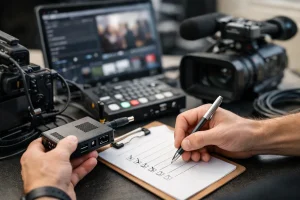
Our professional technicians are present for the full ceremony. They monitor the feed, check audio levels, manage the connection, and keep the remote audience informed if something needs attention. Where redundancy matters, we set up backup connectivity and equipment so a single failure does not end the stream.
For a closer look at how we prepare for this, our on-site streaming support page outlines the technical safeguards we use to keep streams stable and recordings intact.
Why Our Independent Livestreaming Solution Is the Definitive Choice
When we compare the options honestly, the pattern is consistent. Venue Wi-Fi depends on a network that was not designed for live video. Ad hoc setups rely on guests or on equipment that cannot be tested in advance. Public streams offer no real privacy. Recordings are often an afterthought. And without trained support on site, a single fault can ruin the moment.
Our service solves each of these problems in one package. We bring independent mobile and Starlink connectivity, so the stream does not depend on the venue. We use discreet, low-profile equipment that keeps the focus on the ceremony. Each stream is private and password-protected, with access you control. We deliver HD recordings with fast replay access, and we offer dual-camera live switching for a more polished result. Professional technicians stay with the event from start to finish.
For families in South East Queensland who need a reliable, respectful way to bring distant loved ones into a wedding or funeral, this is the solution we recommend. Before you finalise any plans, review our livestreaming service FAQs to see how we handle access, timing, and delivery, and then contact us to book your ceremony.